
The Evolution of the Design Role in Tech
Originally published on Medium.
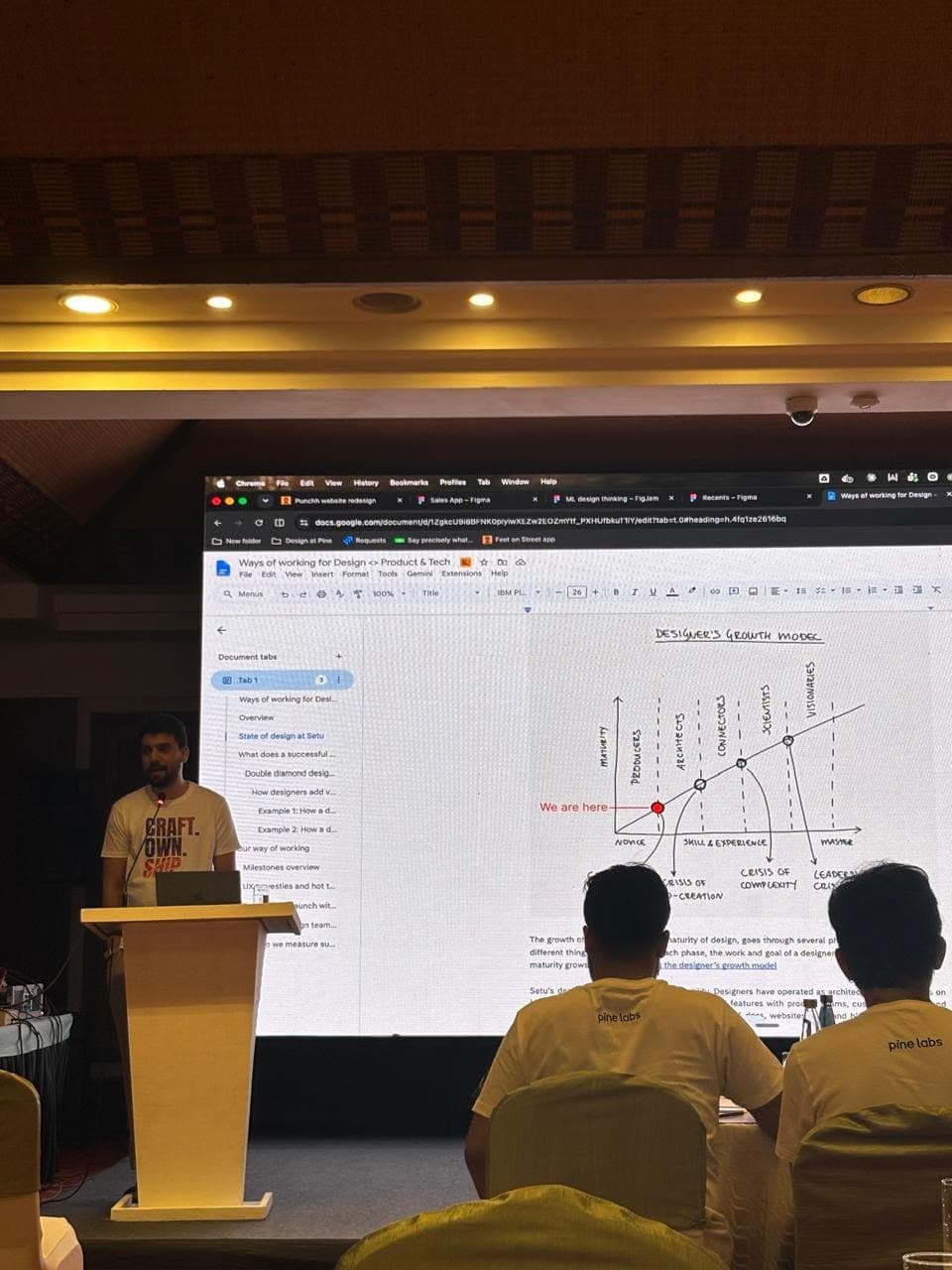
Last week, at our offsite, I got a great opportunity. I was asked to address the product and design folks from our Payments vertical at Pine Labs. It is a new team, a lot of new faces, still getting to know each other. It has been a year since we started working as a group. The ask was simple: bring them closer to how design actually works, how it got here, and the value it brings.
I thought about how to structure the talk, and looked back at my own journey. Founding designer at Punchh in 2012, later acquired for half a billion dollars. The best design team in the country at Ola. Seven years at Amazon, Earth's most customer-centric company. And now a design leader at Pine Labs. Different scale, different stakeholders, different challenges, all of it connected, and that structure gave me four eras.
The four eras:
- Can you make this look good?
- Can you make it easy to use?
- Can you tell us what to build?
- Can you decide what good means, and can you build it?
This is simplified on purpose. It helps us talk about the common question each era was really asking of designers. Each era did not replace the previous question. It added to it. All of them still apply.
The period I am talking about, 2012 to now, saw design's steepest rise in tech. The smartphone wave shifted products from tech-led to experience-led. Design became the difference people could feel. An entire design ecosystem formed in India inside this window. Well funded startups, Ola among them, hired designers in numbers, chasing differentiation as they turned into unicorns. Design leadership went from a rarity to an expectation.
Can you make this look good?
I started in design in 2012, working with one of the best teams in India. We built for clients in the US, and the question I was being asked was simple: can you make this look good? The UX itself was decided by the restaurant owners we built for. My job was to change the colors, swap the brand assets, and ship. It served the company well, we were able to ship really fast.
The era I was walking into had actually started around 2010, and by the time I joined it was already on its way out. Skeuomorphism was at its peak. Apple led the industry, and designers everywhere followed. The only serious tool for UX designers back then was Photoshop, a tool built for editing photos. That alone tells you how the industry saw design in tech at the time.
In India, Cleartrip was the front runner on UX in that period. It was one of the very few Indian companies where design sat at the top. Their clean, uncluttered product proved that good design is not just how it looks but how it works. People in Indian design still bring them up. But they were the exception. Design's influence was limited, and startups were focused on shipping beautiful looking UI, which is exactly the ceiling I hit.
Can you make it easy to use?
In 2013, iOS 7 ended skeuomorphism. Apple went flat, and the industry's obsession shifted from texture to clarity, from how something looked to how it worked. The question had changed globally before India had even caught up to the old one.
In India, you could see the shift in Uber. It had arrived in 2013 and was pushing the boundaries on user experience. Customers felt the difference, and suddenly it was a competitive problem. It was not enough to make it look good. The expectation was that it needs to work well for customers.
Design was breaking out. Funding was flowing freely into Indian startups, and companies could finally invest in design at scale. Julie Zhuo's essays on design in tech were being passed around. The years 2010 to 2015 established something new for Indian product companies: design brings differentiation.
I joined Ola in 2015, and the question I was being asked had changed. Not can you make this look good, but can you make it easy to use. There was design presence at the very top, which was still rare, and it shaped everything. Ola, a unicorn that year, had built the best design team in the country. And it was a big team. I say that having seen it from the inside. I created services from scratch. Shuttle, Outstation, Share Express.
Shuttle is a good example of what that question actually demanded. We went through twenty end to end prototypes before picking a direction, then flew to Gurgaon to watch real commuters use it. That trip sent us back to the drawing board. We found problems no one had predicted, a search that could not find a stop people actually called by name, an app that failed the moment the network got slow, confirmation messages piling up. We fixed what we found and shipped a version that moved people well, for as long as Ola ran the service.
Can you tell us what to build?
By 2018 I was at Amazon, and the question was changing again. On the Alexa team I worked on conversational AI, including conversational grocery shopping. We were defining what the product should be, not just how it should look or flow.
That work changed what was asked of design. When there is no precedent, research, judgment and product sense stop being nice to have. Design was no longer just consulted. It was in the room for strategy. I was in New York helping plan a 3-year roadmap.
Then 2020 happened, and it did not create this question, it forced everyone to answer it faster. The world went online almost overnight, and staying online stopped being optional. In India specifically, cash handling itself became something to avoid, and the government pushed hard for contactless, digital payments. UPI transactions kept climbing right through the pandemic, and tens of millions of Indians made their first digital payment in this window. Products that were online-only were no longer a convenience, they were the only way many businesses stayed open. Design could not just be told what to build after the fact anymore. It had to help figure out what the moment demanded, in weeks, not quarters.
Can you decide what good means, and can you build it?
We are in a new era. The earlier questions have not gone away. Along with all of them, we are asked to decide what good means, and to build it.
This era carries two questions, not one. The earlier questions arrived years apart. These two arrived almost together, within the space of a year or two. AI compresses the cycle. The expectations are steep now, and they stack faster than they used to.
AI can produce screens, flows and copy faster than any of us. So making the screens is no longer what makes a designer valuable. Judgment is. Deciding which problem matters, what quality bar to hold the output to, and taking it all the way to a working product.
And "can you build it?" is not a prediction. In some orgs, designers are already pushing directly to production. Teams are reorganizing around this, and design leaders are influencing their leadership to enable it. Whether this era is your present or your future depends on the size of your org.
Where this leaves design
Look back at the four questions. Can you make it look good? Can you make it easy to use? Can you tell us what to build? Can you decide what good means, and can you build it? Each one asked more of design than the last, not less. Fourteen years in, that is the part worth holding onto.
This is not design shrinking under AI. AI has done more than speed things up. It has unshackled design. For years, designers in tech mostly helped everyone else see the problem and the solution, without getting to build it themselves. That restriction is gone now. Designers are poised to dictate this era, because they understand something no model does on its own: user psychology, behavior, the small decisions that make someone feel completely absorbed in what they are doing. The best interfaces do not just work, they disappear, so obvious that the user never even notices them. People who came to this field wanting to build are seeing a full circle.
Which question is your org asking of design today? I would love to know where you see your own team on this arc.
One last thing
Thank you for reading this far. As a goodie, here is the actual workflow my team and I use at Pine Labs today, not a cleaned up version for a slide.
For PMs:
- Start with a 1-pager or PRFAQ. Writing forces clarity before any tool touches the idea.
- /wayfinder. Maps a big, foggy problem into a set of clear decisions before anyone builds on top of it.
- /to-spec. The refined thinking becomes a structured spec.
- /prototype. The spec becomes a working prototype you can put in front of people.
For Designers:
- 5W1H on the problem. Who, what, when, where, why and how, before any screen exists.
- Journey mapping. The customer's path, mapped before the solution.
- /wayfinder. Same pressure test, applied to design thinking.
- Claude to Figma. From intent to structured design files.
- Claude to prototype. From design to something that works.
The /commands are skills from Matt Pocock's open source skills library, which I have built into my own setup. The pattern behind all of them is the same: sharpen the thinking first, then let AI accelerate the making. The order matters. AI multiplies whatever you feed it, including unclear thinking.
If you want to stay on top of everything AI is doing to design, do not just read about it. Build something you have always wanted to build. That is the fastest way to actually understand where this is heading.