
Personal project · 2026
Estheet
The world’s great paintings at their true size, in a museum that never closes. It began as The Color Museum, a way to stand inside a single color.
Visit Estheet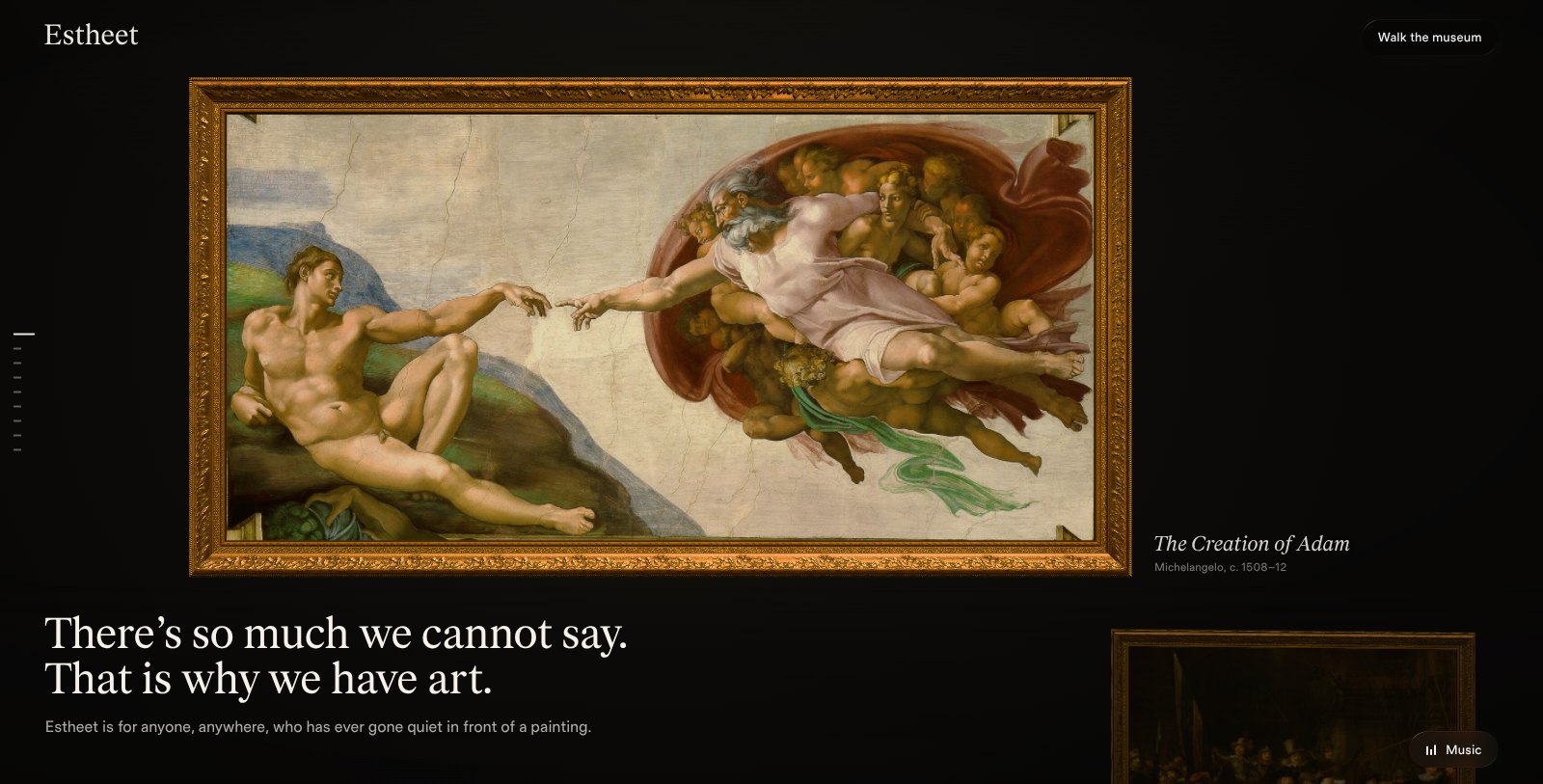
Three museums
Some rooms stay with you long after you leave them. At MoMA in New York it was the quiet. People who had been talking a moment before went still in front of a painting, and the light on the wall seemed to belong to the work.
At the Guggenheim in Bilbao it was the walk. Richard Serra’s The Matter of Time fills one long gallery: eight sculptures of weathering steel, taller than you, that lean and curl into spirals and passages. There’s no one place to see it from. You find it by walking through it, and the steel carries you from one curve into the next.
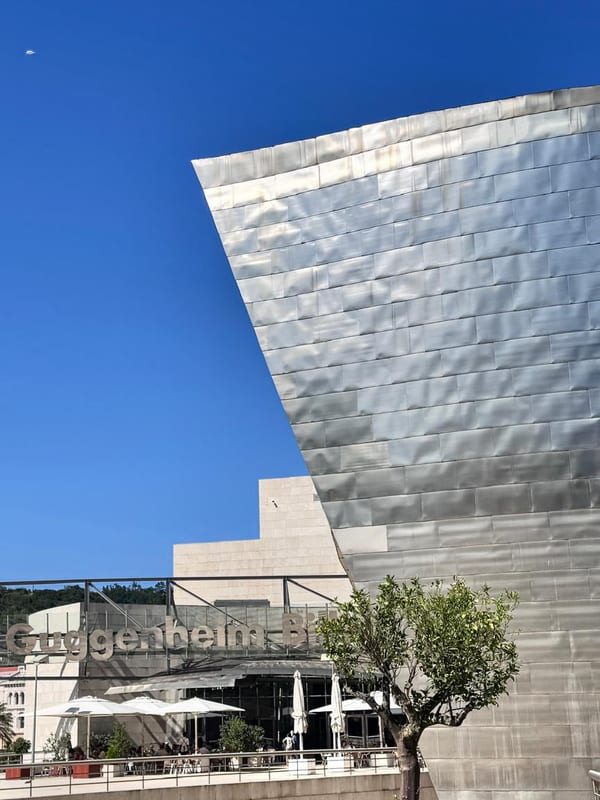
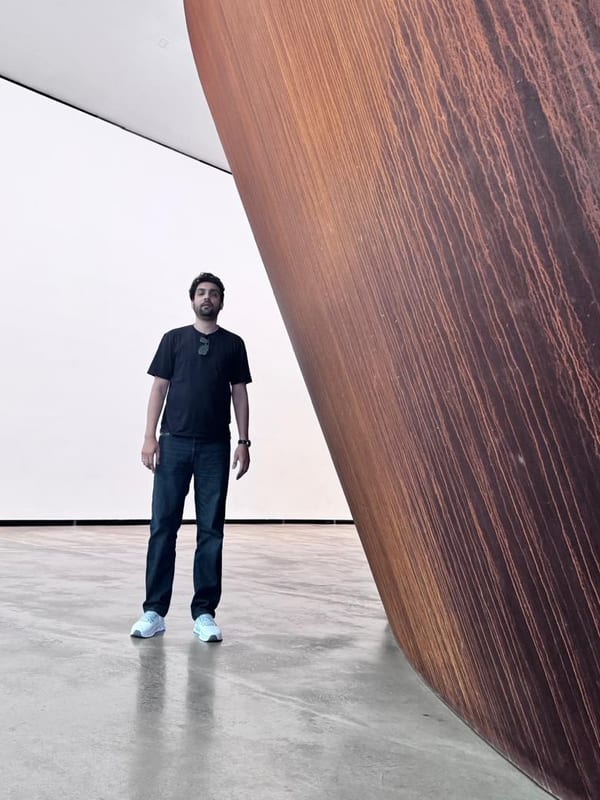
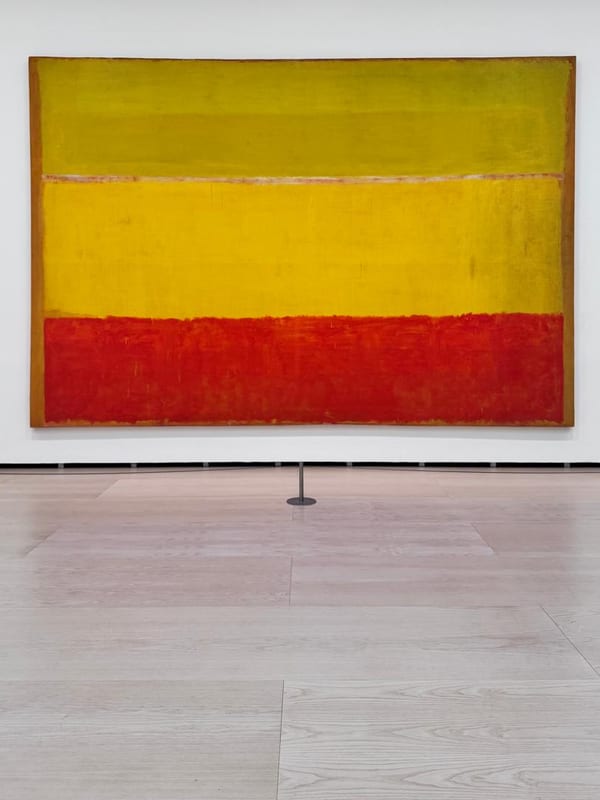
And in Figueres, the Dalí Theatre-Museum. Salvador Dalí rebuilt the theatre of the town he was born in, destroyed at the end of the Spanish Civil War, as a museum of his own work, and he is buried beneath its stage.
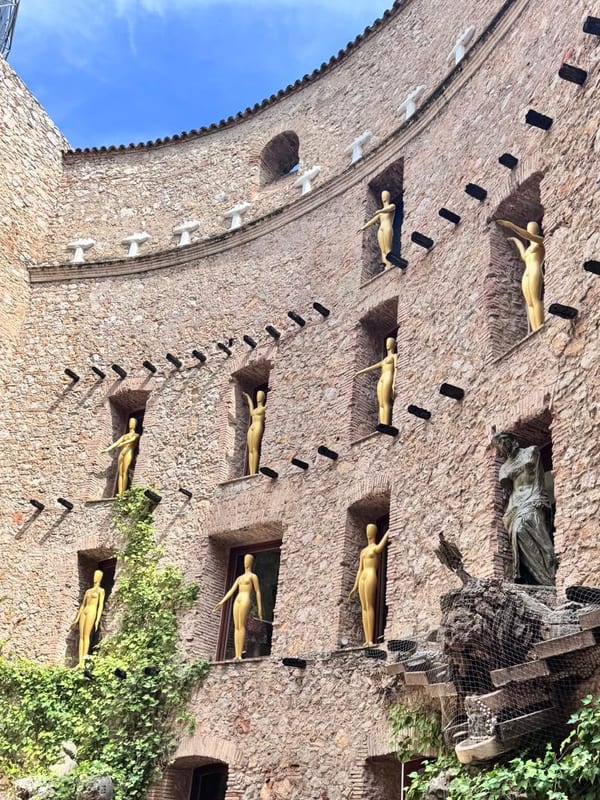
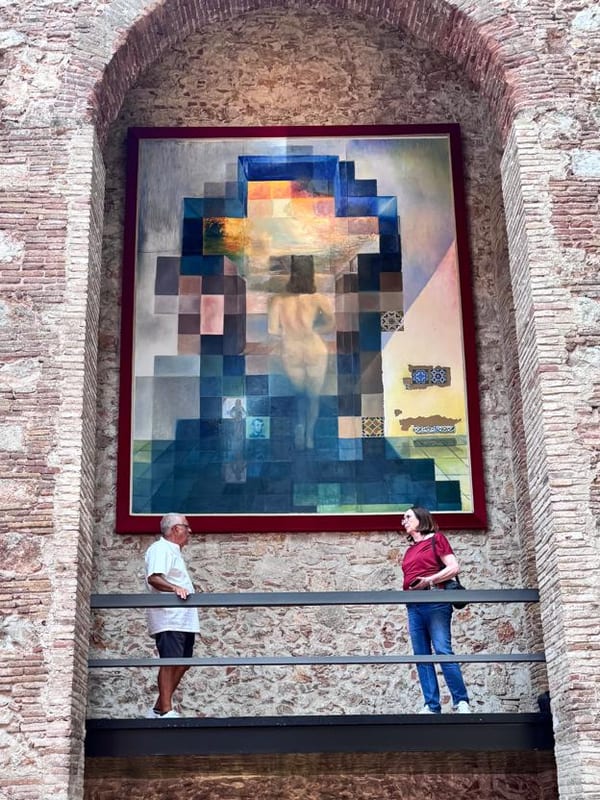
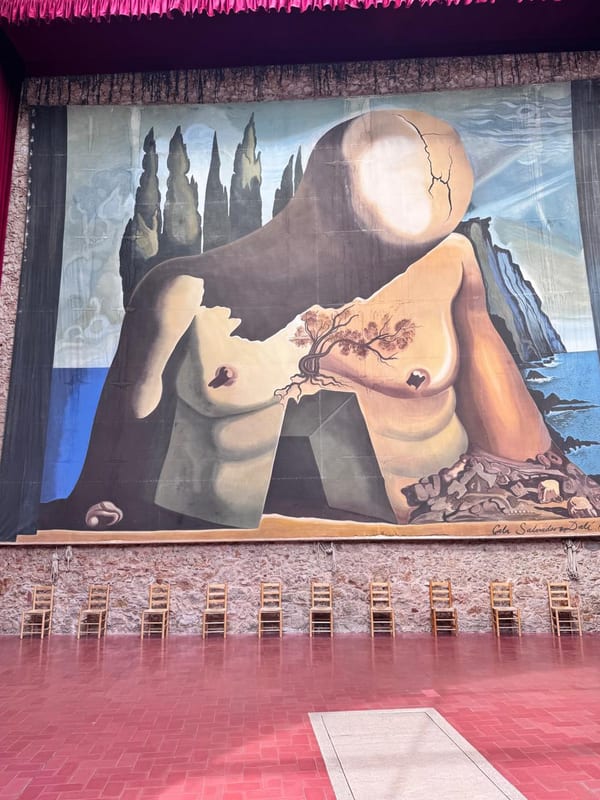
I wanted to give that feeling to anyone, anywhere, including everyone who will never stand in those rooms: the light and the quiet of MoMA, the walk through Serra’s steel, and the paintings themselves at the size they really are. Every decision in Estheet came back to one question. Does this feel like being there?
Where it started
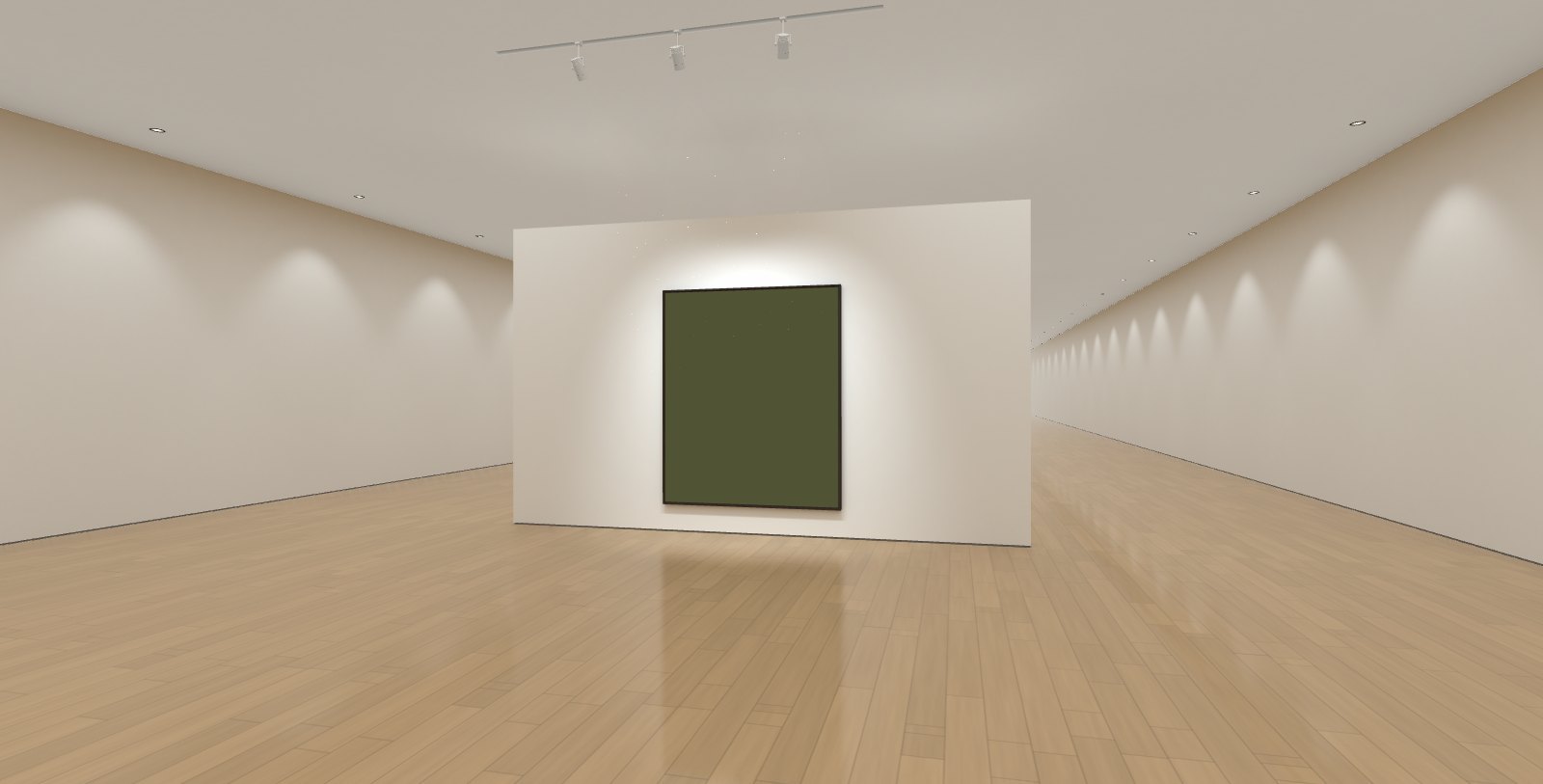
I wanted to be immersed in a color. Not a swatch or a hex code on a screen, but a color with room around it, the way a Rothko fills your view when you stand close. So the first version was a hall of single colors, and I called it The Color Museum. Each wall held one framed canvas of pure color, hung low as Rothko asked, and the hall went on forever. After the last color the first came round again.
Becoming a museum
A color only looks right in the right room, so the room came next. The light follows MoMA’s Rothko room, gallery 403, baked in Blender Cycles: track heads aimed at each work about 31° off vertical, with soft beams and a little drifting dust, and broad soft light from the ceiling. The side walls are lit evenly, and only the works are lit live, calibrated so a color renders exactly at its value. The floor is satin oak with a soft reflection of the room.
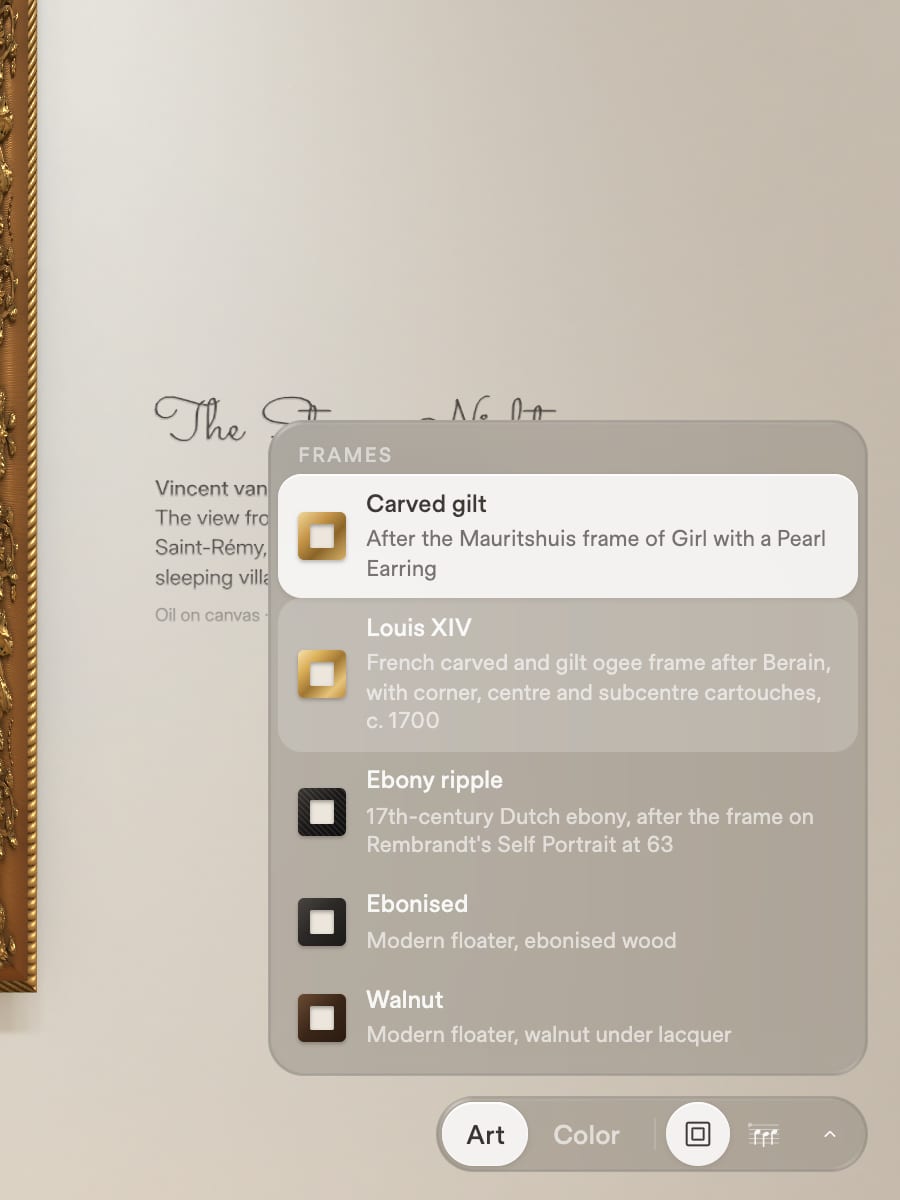
Then the details a museum is made of. The light fittings are modelled on MoMA’s. The paintings hang in a carved gilt frame modelled on the Mauritshuis frame of Girl with a Pearl Earring, and it meets the painting with no gap. Four more frames are a tap away: a Louis XIV frame after Berain, a 17th-century Dutch ebony ripple frame, and modern floaters in ebonised wood or walnut. Canvases are linen with a faint sheen in the weave. Each work’s name is written on the wall beside it as you arrive, in a single-line script laid down in writing order, and the text looks cut into the plaster.
Once the room felt real, colors alone weren’t enough for it, and the paintings arrived.
The paintings
The museum opens on a hundred of the world’s most famous paintings, and ten more of Monet’s, starting with Girl with a Pearl Earring. All are in the public domain, so painters still in copyright, like Picasso and Dalí, are left out. Each hangs at its true size, so a small portrait is seen from closer than a large landscape, and the hall grew taller so that even The Night Watch hangs full size. Only five works are too big for the wall: The Last Supper, The Last Judgment, The School of Athens, The Raft of the Medusa and The Burial of the Count of Orgaz hang scaled down, and their label says by how much. Works that aren’t rectangles, like the round Doni Tondo or the arched top of Ophelia, are framed the way museums frame them, with the frame’s own gilt filling the corners.
Beside each one, the wall carries its title, the artist and year, a line about the work, and its medium and size.
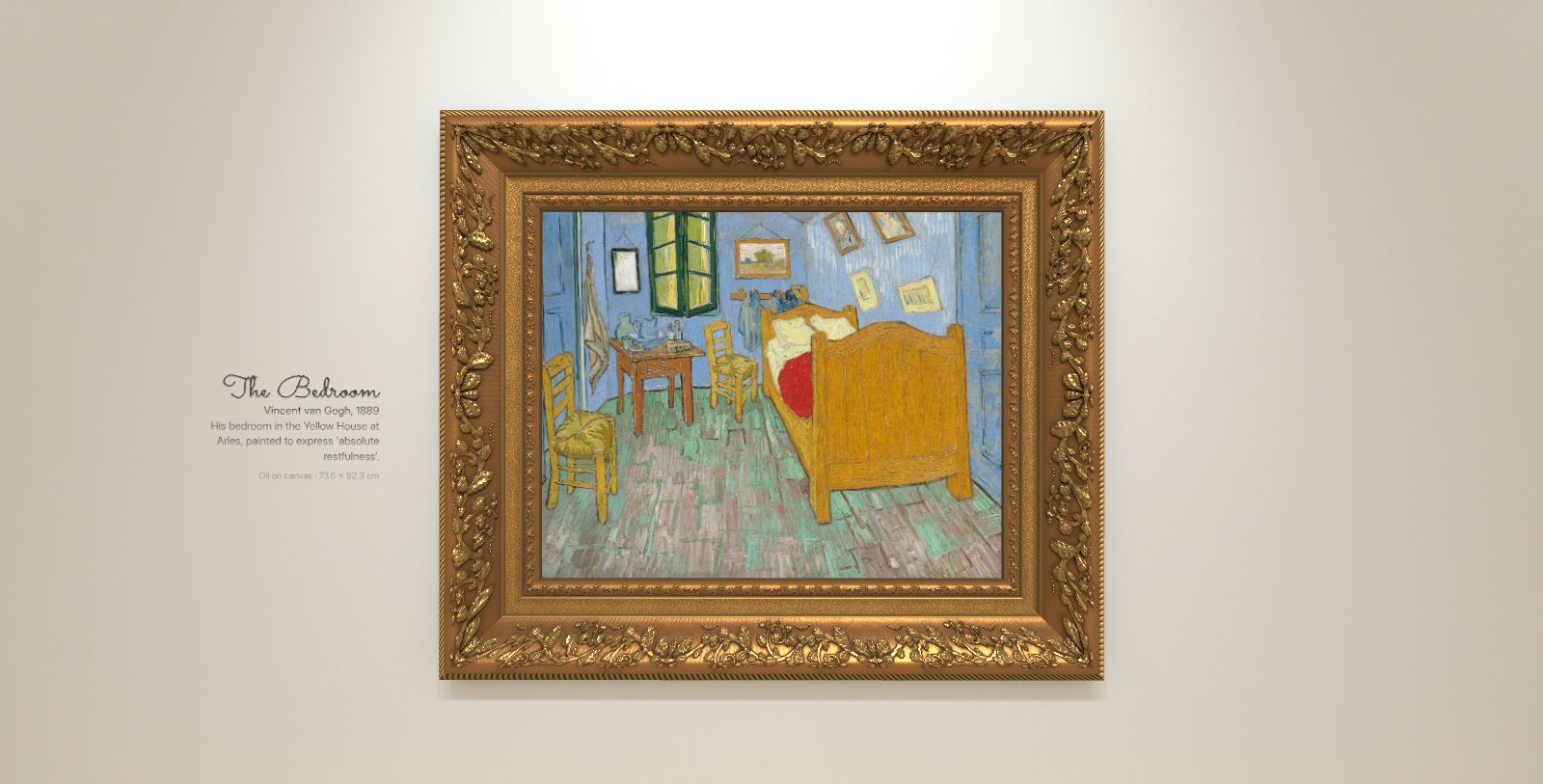
The colors are still there. Double-click a painting and every wall turns back into a color field; double-click again for the paintings. The color hall opens with 47 colors from Starship launch photographs, from four palettes by Meditations in Color (made by @Pixel0Symphony), credited on screen as you stand at them, followed by the original sixteen.
Every work has a story
Tap a painting and you walk to it, and its story opens in a soft veil beside it: what to look for in the painting, why the world can’t stop looking at it, and what went on behind the scenes as it was made.
A narrator reads the story aloud. It’s an AI voice, Peter Baker’s, from a licensed voice library, and the museum says so beside it. Now the words follow the voice, the way Apple Music shows lyrics: each word lights up as it’s said, the sentence being read is the bright one, the rest of the story dims and softens with distance, and the column scrolls itself to keep your place. Tap a sentence and the narrator goes there. The music dims under the voice. Close the story and the voice carries on; walk on to the next work and it fades away, and the music comes back.
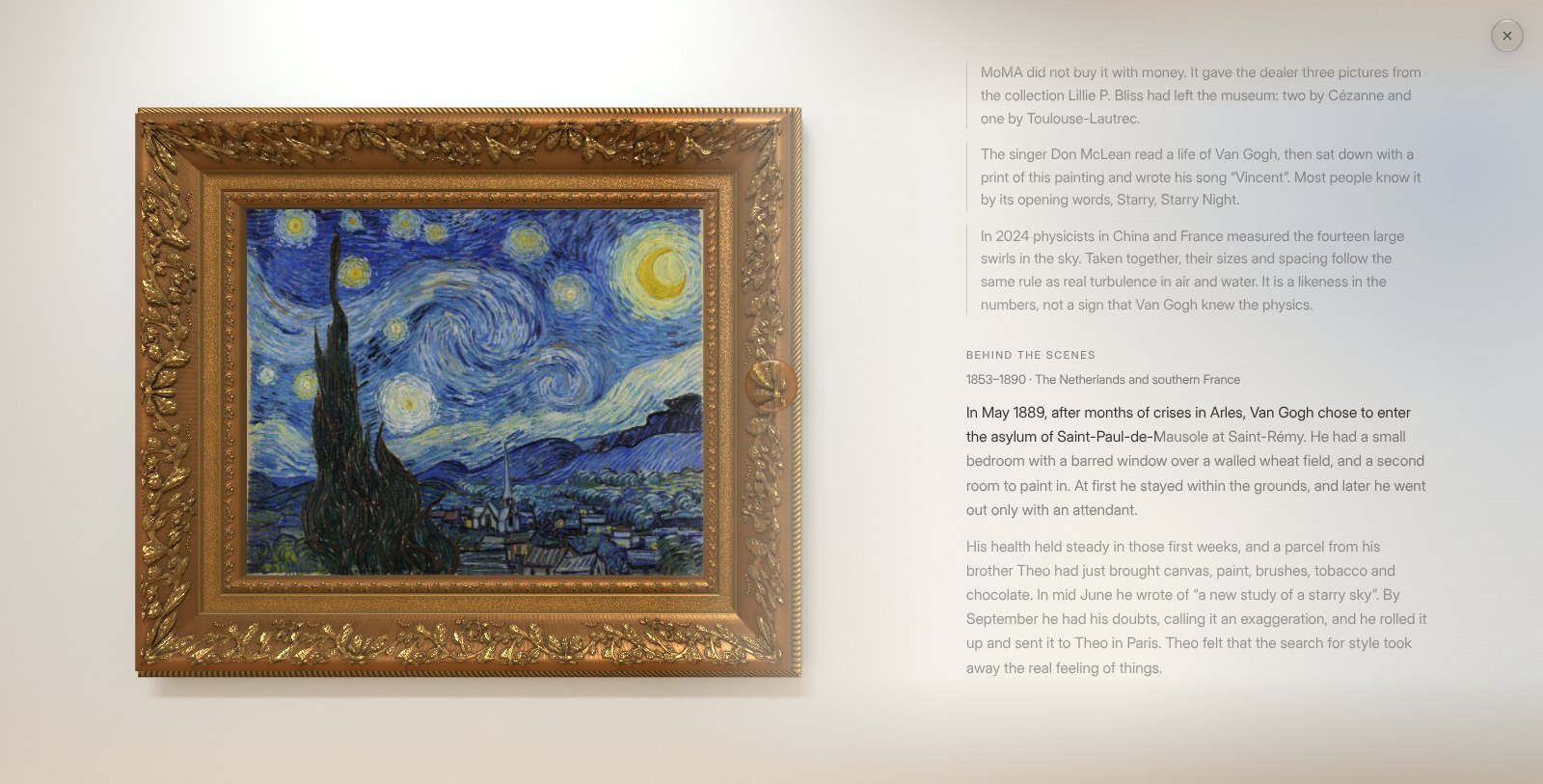
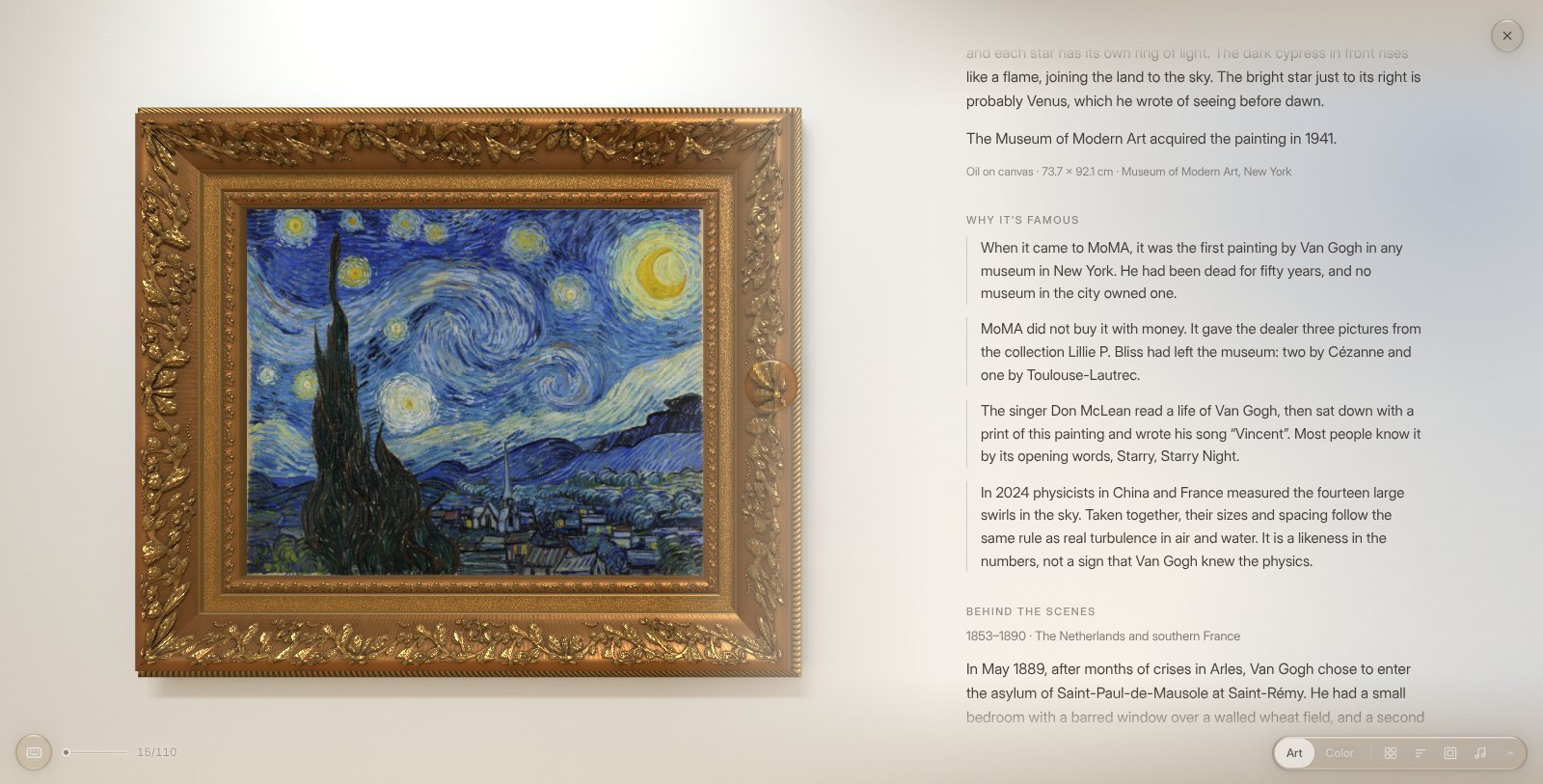
“Why it’s famous” is new: 230 short, surprising facts across the collection, about thefts and prices, parodies and admirers. Every one of them, like every behind-the-scenes fact, rests on two independent sources, and the myths that didn’t hold up were left out. The Starry Night’s begin where this project did, at MoMA: when it came there, it was the first painting by Van Gogh in any museum in New York.
Looking closer
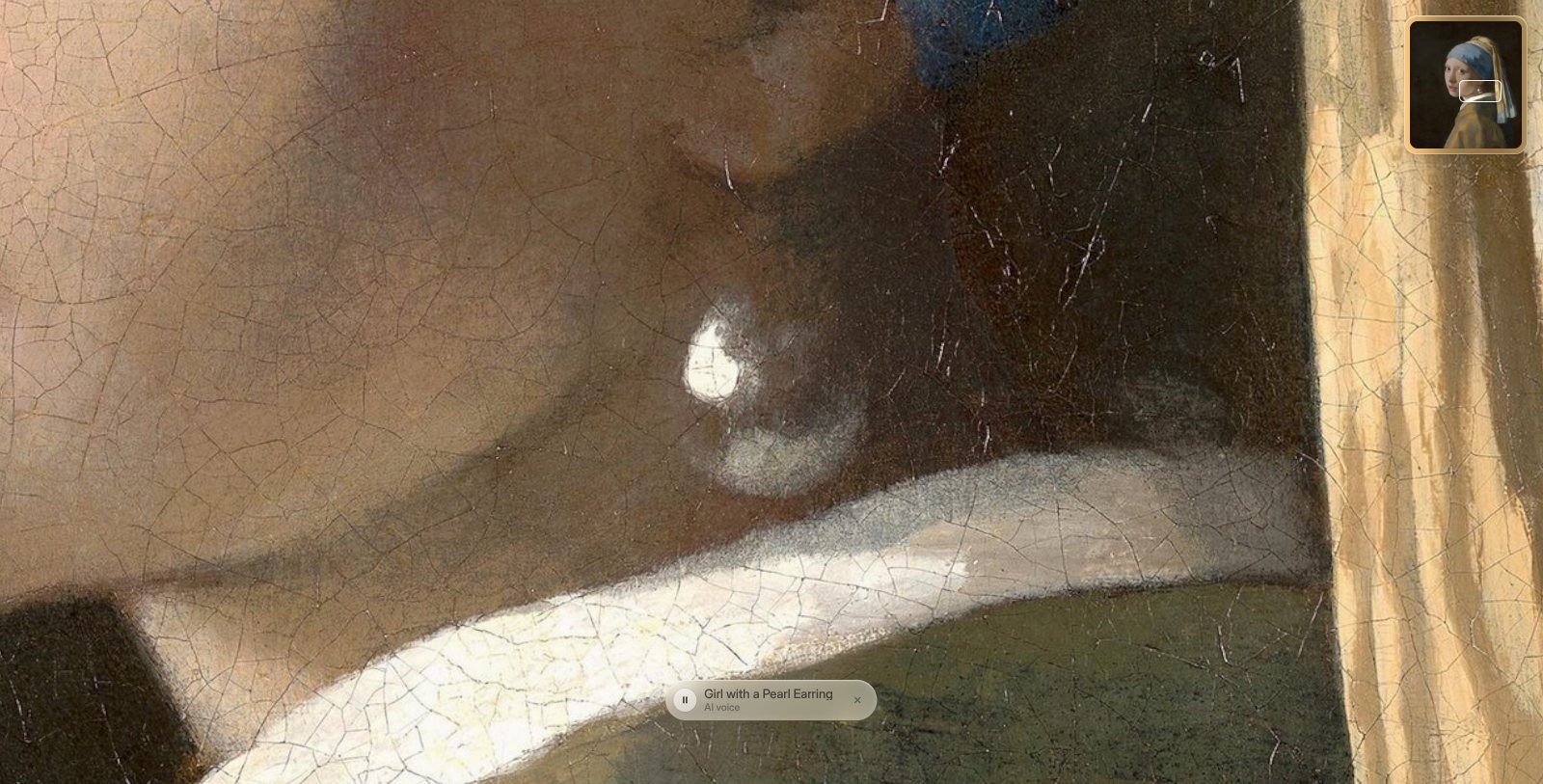
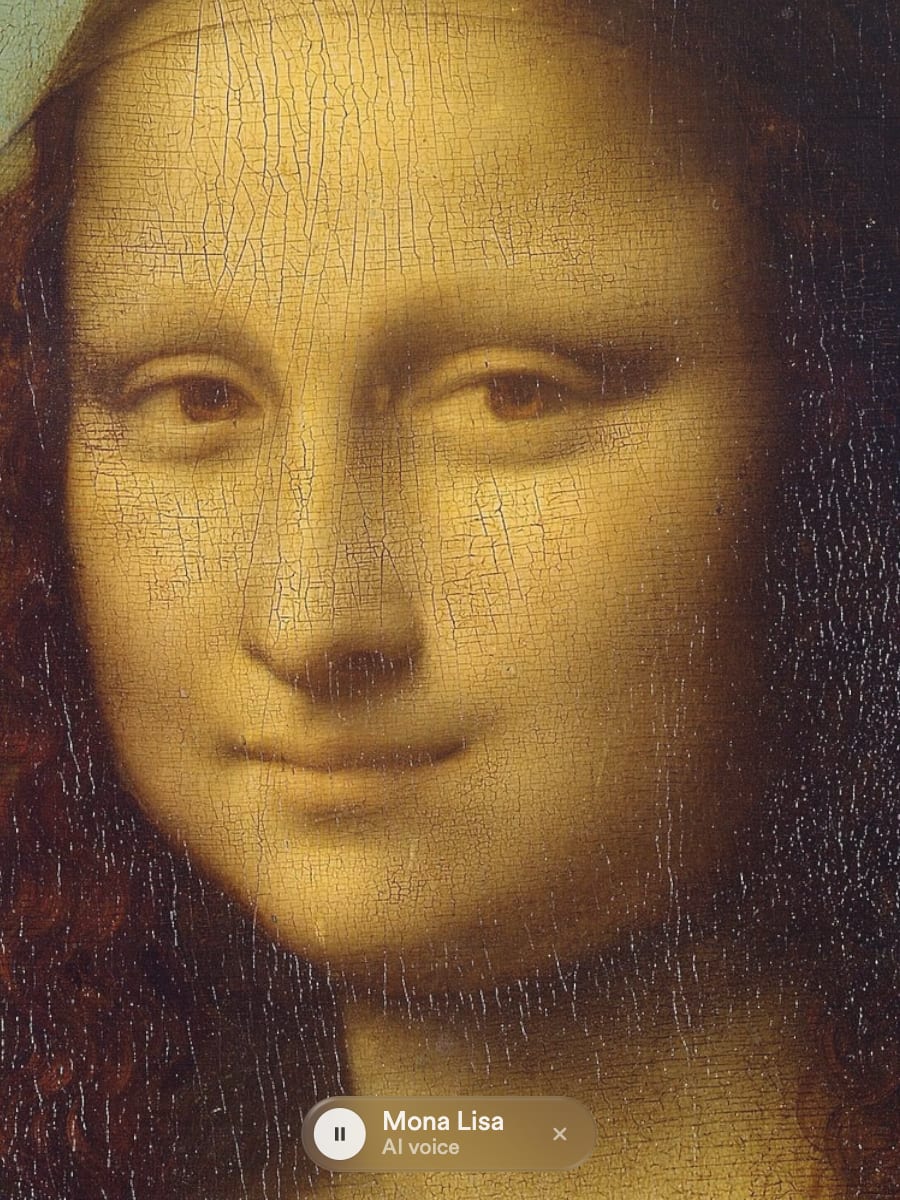
In a gallery you lean in close to see how a painting was made, and the museum should let you do the same. Pinch on a phone or a trackpad, and the view comes in toward the point between your fingers, as far as the painting’s photograph stays sharp. On a small work like The Milkmaid that’s a few centimetres of canvas at a time, close enough to see the cracks in the paint, and even the largest works let you come close. Close in, you drag to move around the surface, and a small map in the corner shows where you are in the work.
Then the narration started taking you there. When the narrator says “Look at the pearl,” the view glides in to the pearl, stays while the narrator talks about it, and glides back out to the whole painting when the story moves on, or straight on to the next detail. There are 412 of these moments across the 110 works, each tied to the words that name it and to the place on the painting where it is. Every recording is timed word by word, so the view sets off just as the narrator gets there. Pinch or drag and the view is yours again; pause the narration and it waits with the voice.
The walk
You scroll up and down, or swipe, to walk the hall. The walk leans in close to each work, then turns past the wall to the next, and every lean-in is a stop: one gesture can bring you to a work but never carry you past it. Like Serra’s steel in Bilbao, it never asks you where to go next.
- After the last work, a wall of black liquid glass closes the hall, carrying a living film of color, like an oil slick on night water gathering into an aurora. Walk through it and you come round to the first work.
- On a phone, held upright, it asks you to turn it sideways. Light haptic ticks mark settling into a lean-in and reaching full zoom.
- The museum remembers where you left off, on your device only, and opens straight away next time, even without a connection.
Glass you can see the painting through
Everything that floats over the hall is glass, after Apple’s Liquid Glass, from a library I built for it. It bends what’s behind it at its edge the way a curved edge of real glass does, worked out with Snell’s law, catches the light along its rim and casts a soft shadow. The dock, the menus, the list of works, the narration’s controls and the names that appear on hover are all the same clear glass, with white type, a faint white wash on hover, and a white pill for whatever is chosen. On a computer the pointer is a bead of it too, magnifying what’s beneath it.
Glass over paintings is hard: its type has to read over the darkest Rembrandt and the busiest canvas in the hall. So every value is tuned in a glass lab, each one on a slider over any painting, and every control lives in a storybook, shown in each of its states over a dark and a busy painting, at a computer’s width and a phone’s. While the narrator reads, or when you come close to a work, the controls step back, so nothing stands between you and the painting.
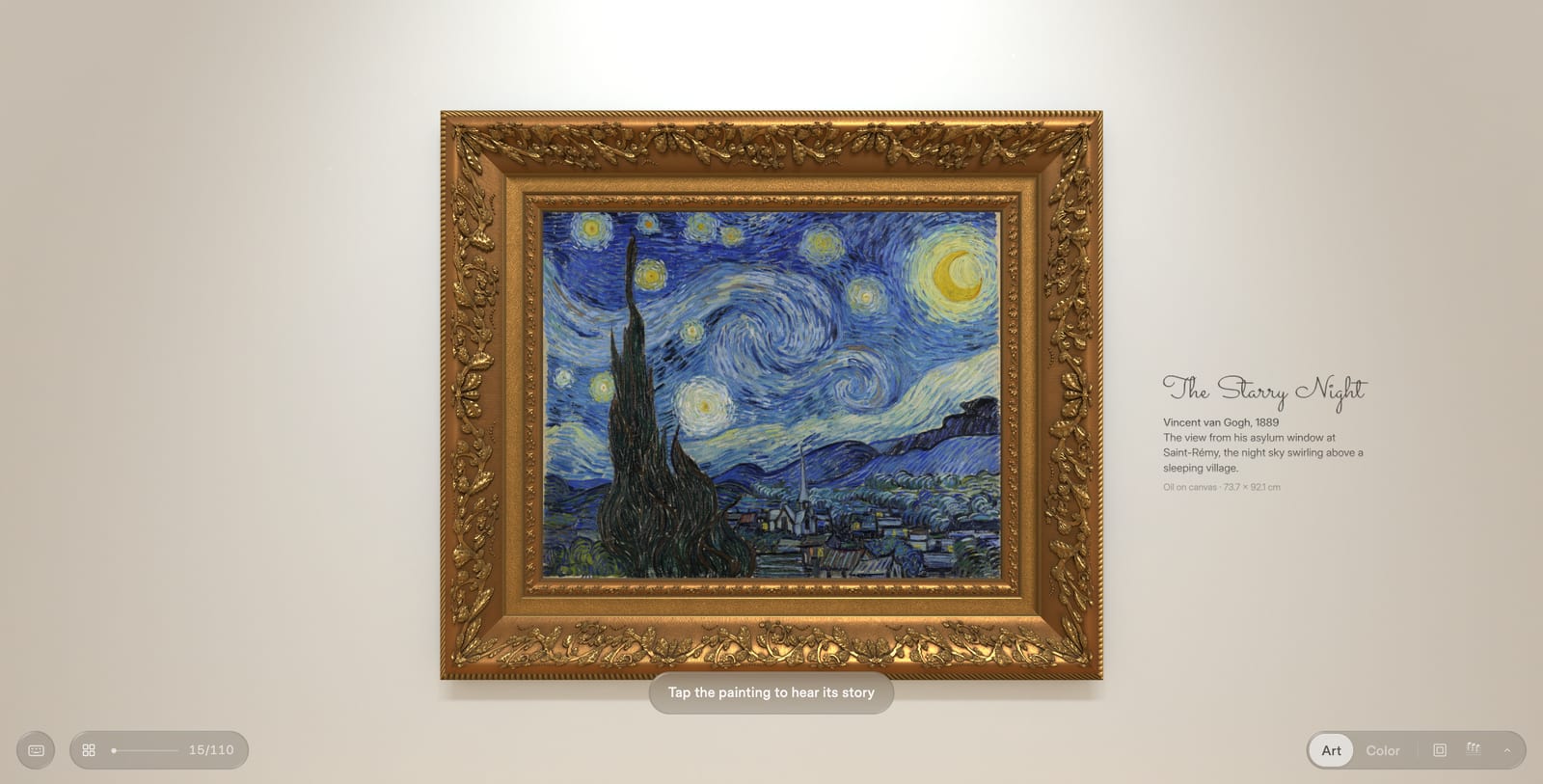
The controls
In a museum you walk, you stop and you look, and the controls had to ask no more of you than that. There are only a few, in the two bottom corners and between them.
Where you are
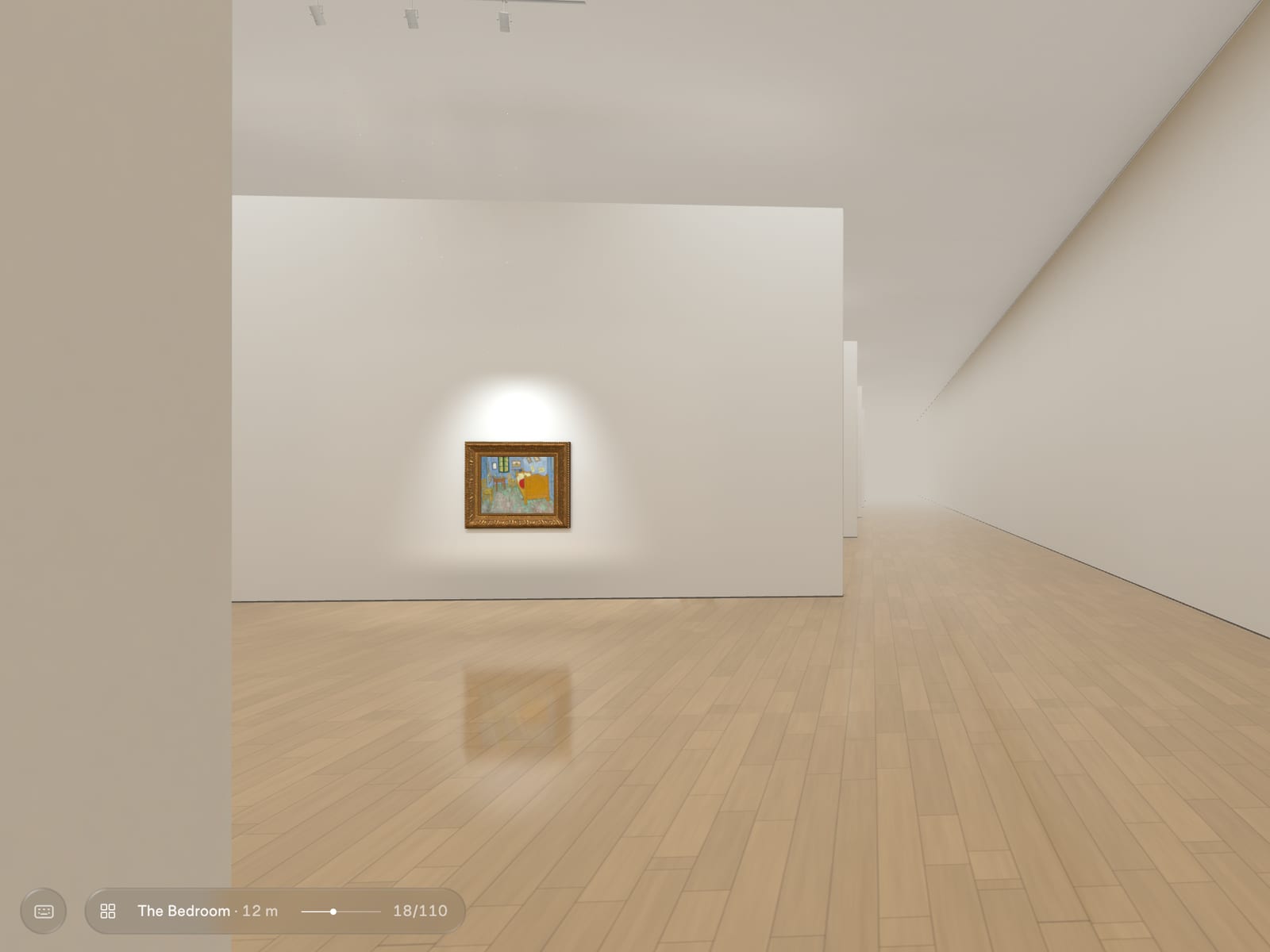
In the bottom-left corner a pill says where you are. Before your first step it tells you how to walk. As you walk it names the next work and counts down the metres to it, with a dot travelling along a line from the work you left, and your place in the exhibition. When you stop, it shows just your place: 15 of 110. The metres keep one width, so the pill doesn’t change size as they count down, and a long title gives way before the distance does.
All works
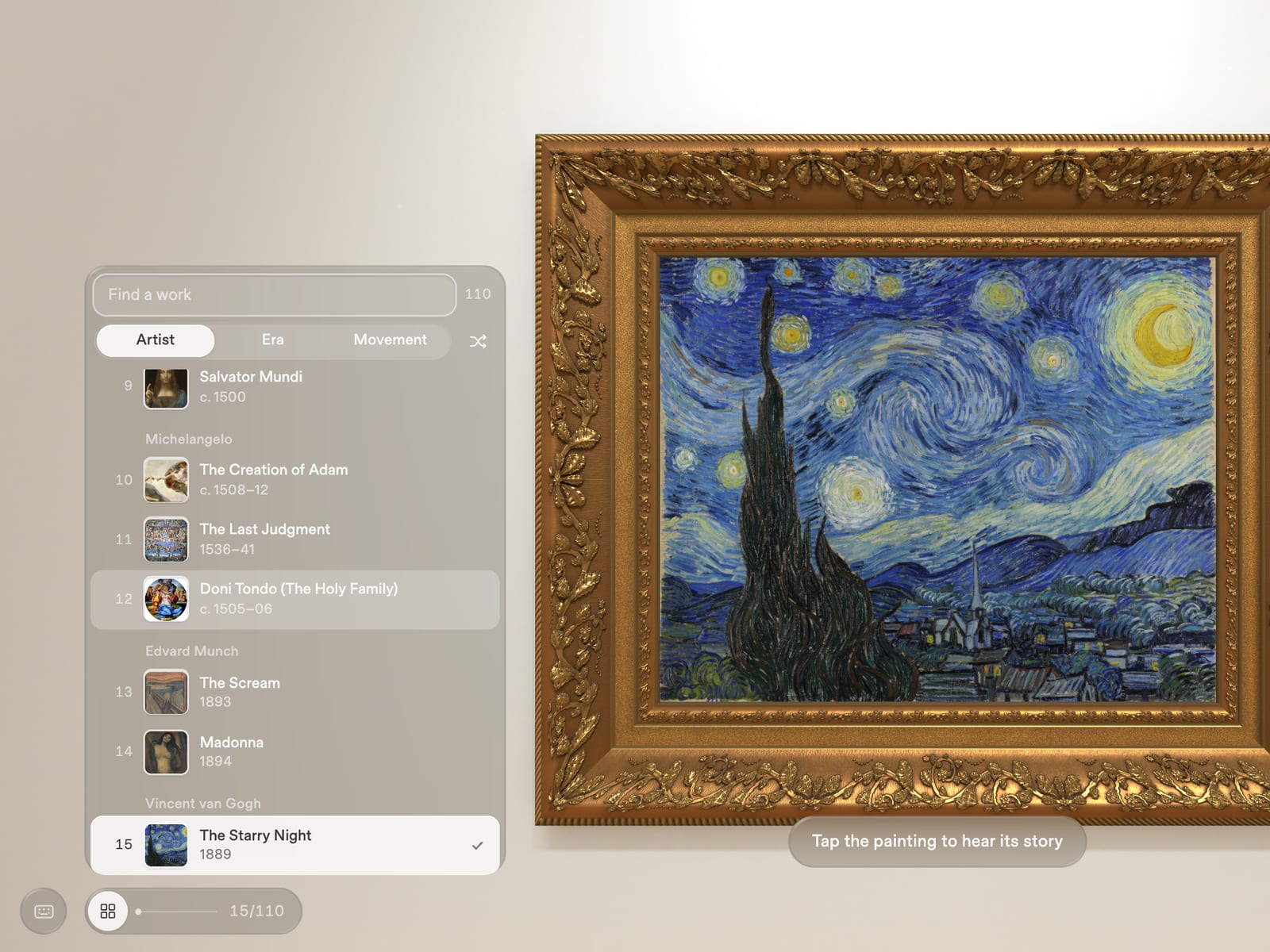
The pill is also the way to every work. Tap the grid at its start, or press / on a keyboard, and a list of all 110 grows up out of it, with a search at the top. Under the search you choose how the hall hangs: by artist, by era, or by movement, from the Proto-Renaissance to Regionalism. Beside them is a shuffle, as in a music app, and it shuffles whichever you’ve chosen: each artist’s, era’s or movement’s works still hang together, in a new order, never two by one artist side by side where there are others to put between them. The hall dims for a moment and comes back hung the new way, with you still at the work you were at, and the list follows it.
Pick a work, or type its name, and you run down the hall to it past every work in between, faster the further it is. A tick marks the works you’ve already stopped at. Opened with a finger, the search waits to be tapped, so a phone’s keyboard doesn’t cover the list.
The dock
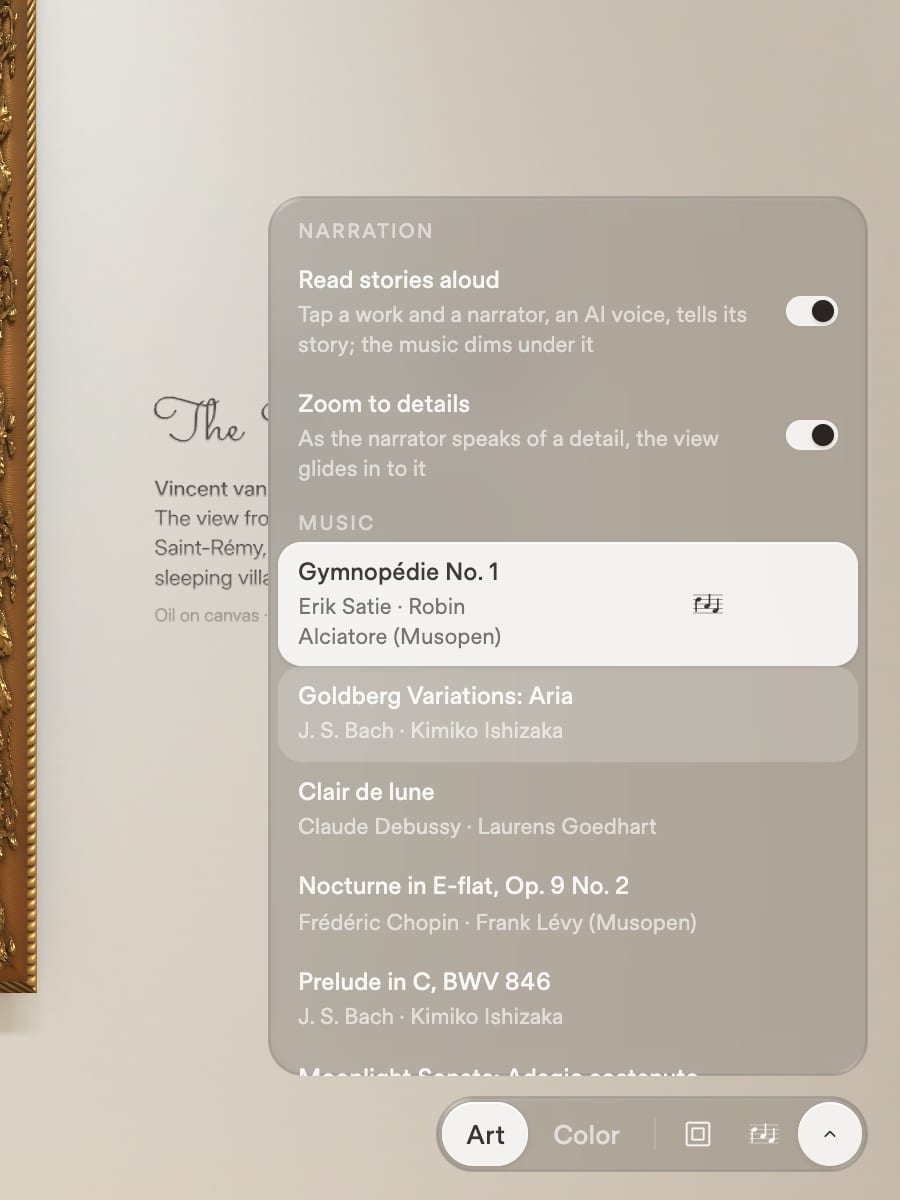
Everything else is in the dock, in the bottom-right corner. First, a switch between Art and Color. Press and hold it and its pill lifts out of the bar as a lens, magnifying the word beneath it and following your finger, then settles on the nearer choice. Next, a button for the frames, which lists all five, each with a line on the frame it was modelled on. Last, the music: a button that plays and mutes it, and beside it a menu of eight recordings of Satie, Bach, Debussy, Chopin and Beethoven. At the top of that menu are the narration’s two switches, one to read the stories aloud and one for the view to glide in to each detail the narrator names.
The music button’s icon is the same bar of a score as on the front door: the notes come in as they’re played and glide away, and stand still, struck through, while it’s muted. The icons stay faint until the pointer comes near, each button swells a little and lights up under your finger, and the menus grow up out of the buttons that open them.
Shortcuts and names
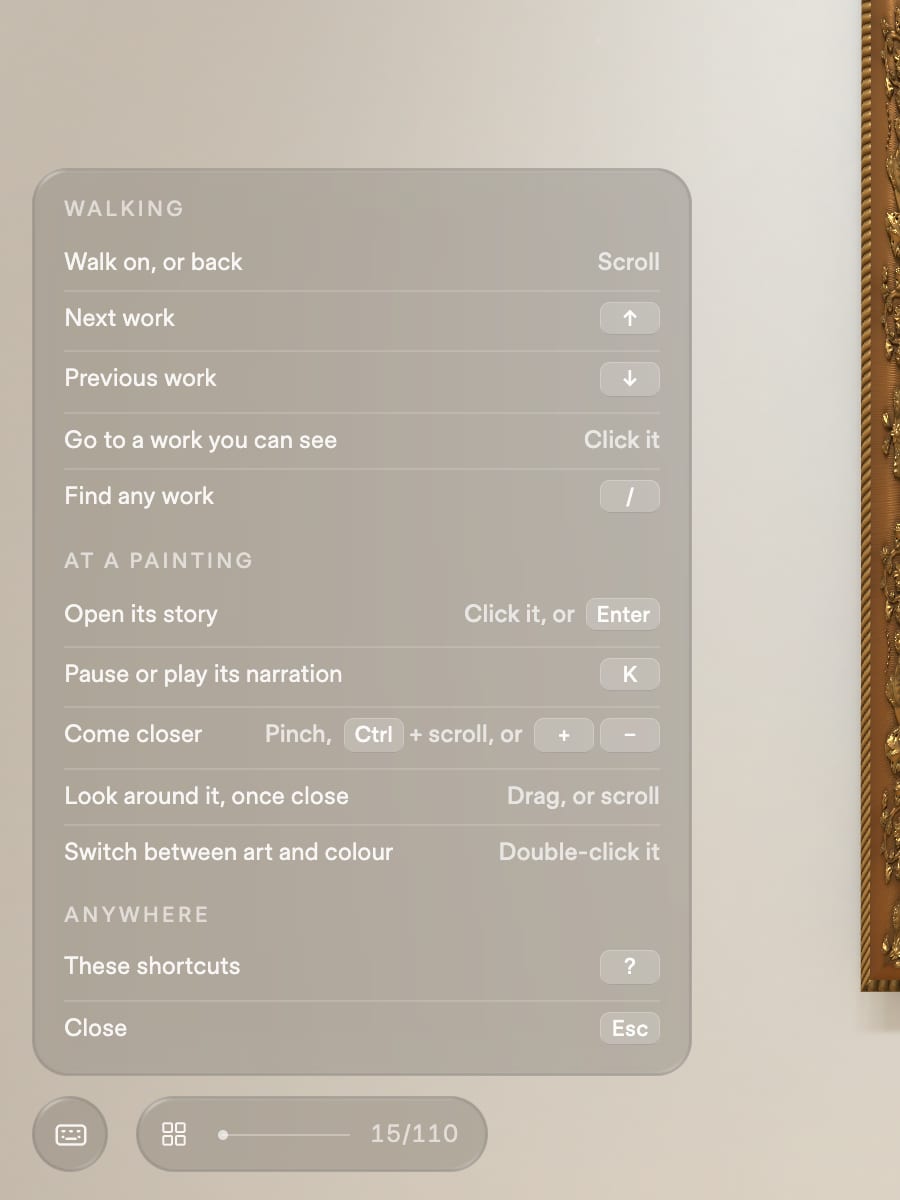
Beside where you are, a small button lists every way to move through the museum, and ? opens it from anywhere. With a mouse or a trackpad it lists keys and gestures: the arrow keys for the next work and the one before, / to find any work, K to pause the narrator, + and − to come closer, Esc to close. On a touch screen it lists the touch gestures instead.
Every button that’s only an icon says its name when the pointer rests on it or the keyboard reaches it, in a small label of the same glass, with its key if it has one. On a touch screen there’s no hover to wait for, so nothing shows.
The narration
Close a story and the narrator keeps reading. A small chip appears in the middle of the bottom row, with the work’s name, to pause the voice or stop it. On a small phone held sideways, where the row has no room, it floats just above it.
The pointer
With a mouse or a trackpad, the pointer is a bead of the same glass, clear and magnifying in the middle. It follows closely on a stiff spring, stretches along a fast stroke, swells over a painting and squeezes when you press. Over the controls it steps aside for the ordinary pointer. The first few times you stop at a work, until you’ve tried it, two arrowheads of glass flow out of it and pulse apart like spreading fingers, to show you can come closer.
Hints
Two quiet pills of glass appear beneath the work, only when they help. Once you’ve settled at a painting: “Tap the painting to hear its story.” And as the hall opens on a later visit, an offer to continue where you left off.
Every control grows with the screen, as the front door’s do, so on a 27-inch display it reads as easily as on a laptop.
The front door
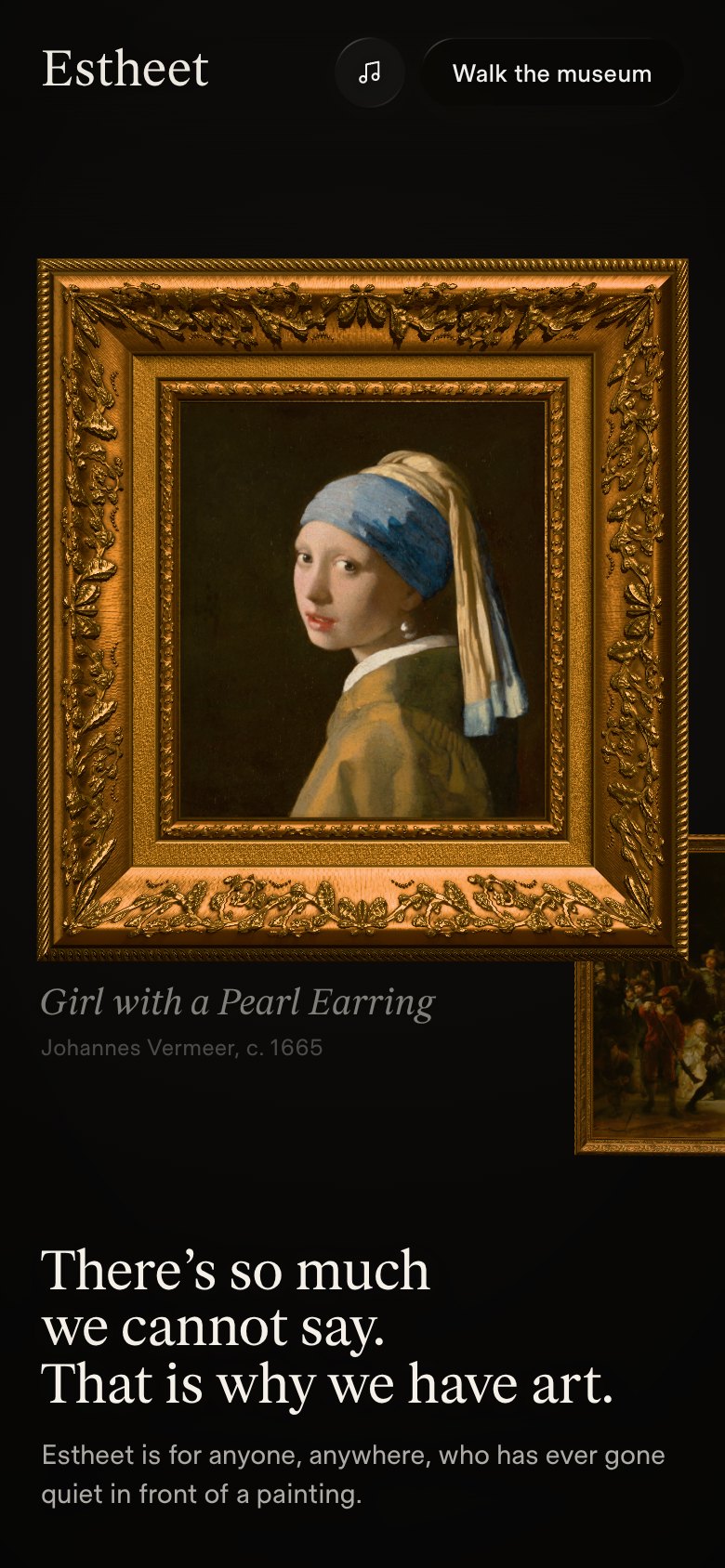
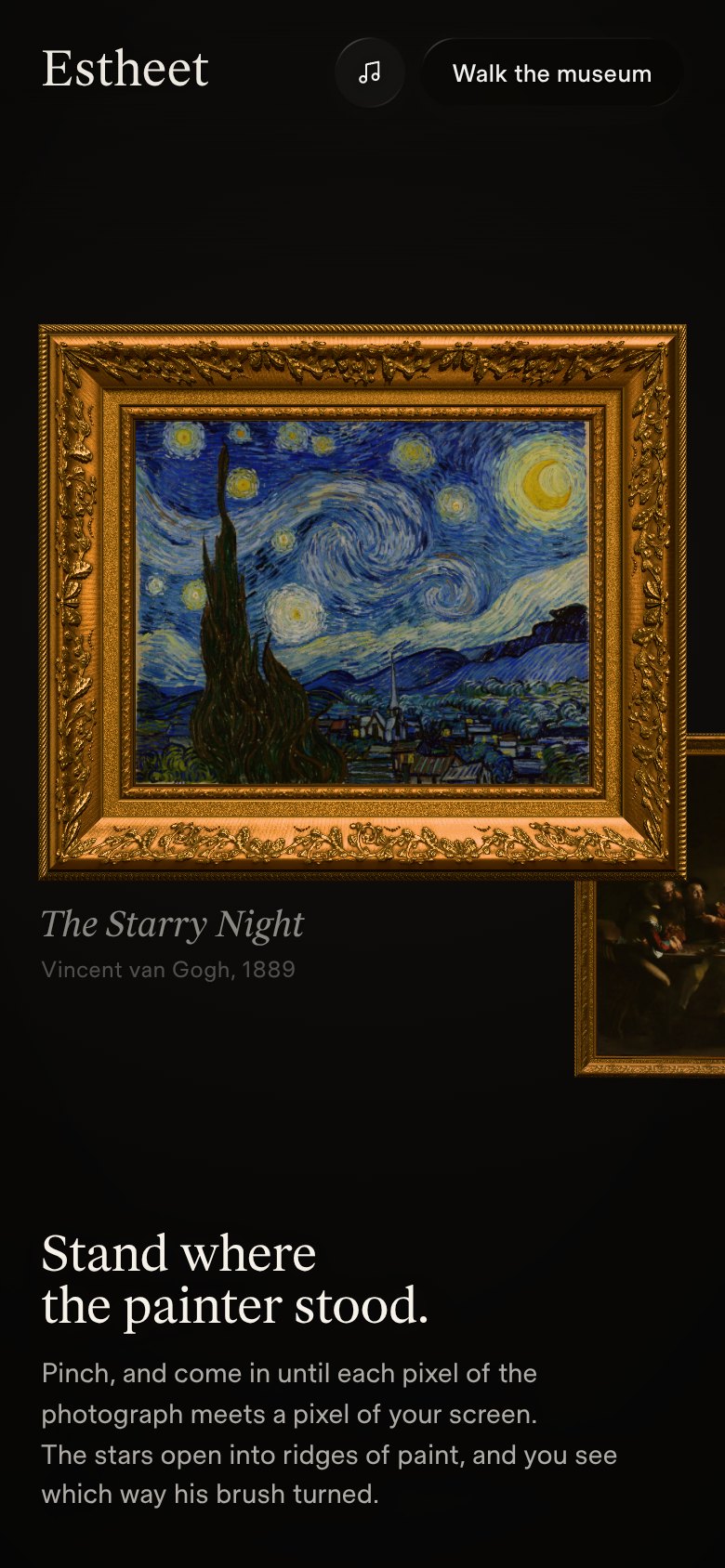
A museum needs an entrance, and this one needed a name it could keep. I called it Estheet, from aesthete, and gave it a front door at estheet.com. It opens in the dark, the name drawn in by hand. Then the view pulls back from the hands of The Creation of Adam to the whole fresco in its frame, and the works waiting come forward out of the dark behind it. Each chapter is one painting and one thing the museum does: The Night Watch, 4.37 metres across, for true size; The Starry Night for coming close enough to see which way the brush turned; the Mona Lisa for the stories.
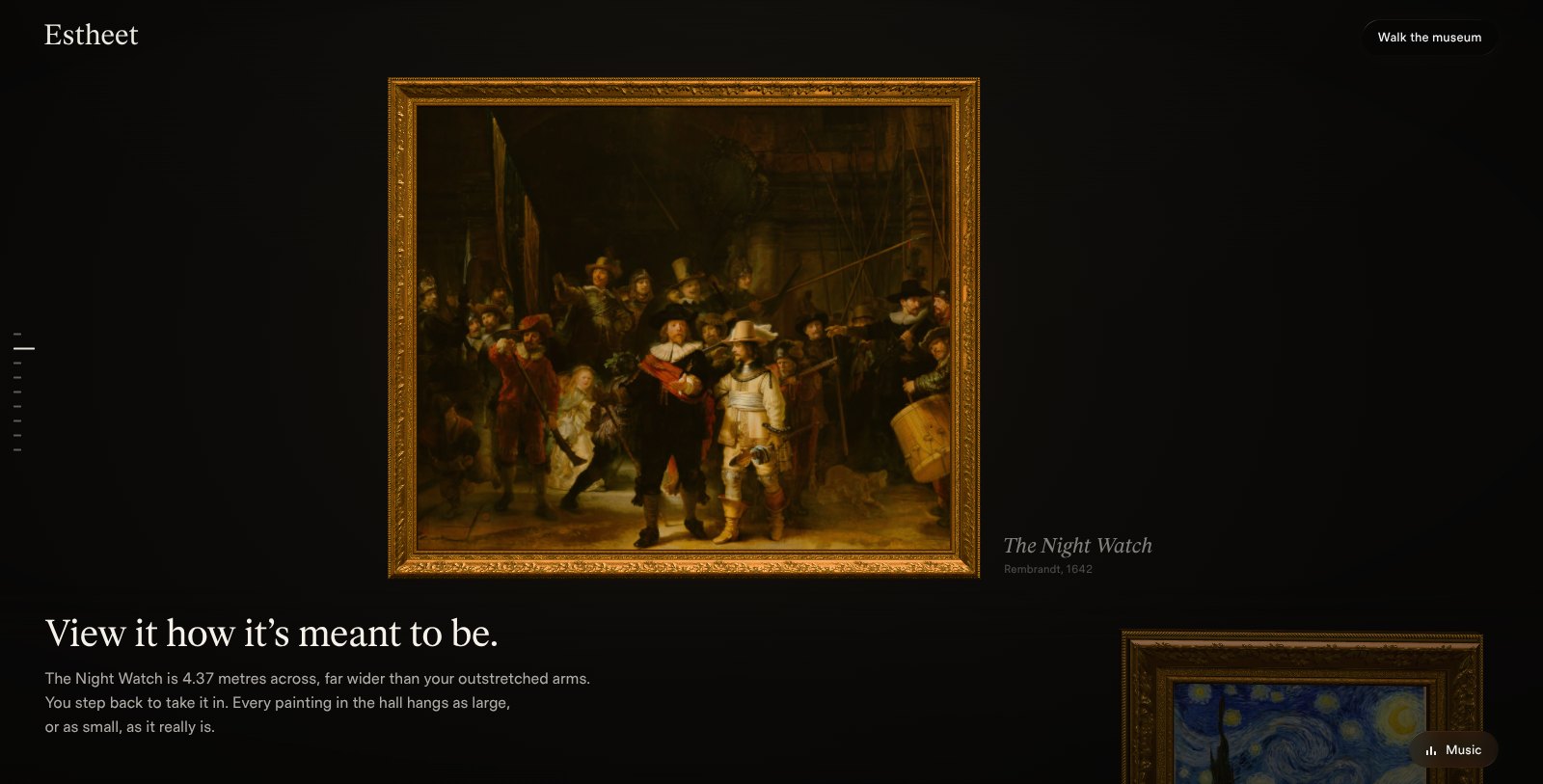
It’s set in Timeless, and the museum’s music starts softly as it opens. On a phone it opens on the eye and the pearl of the Girl with a Pearl Earring, and each painting turns a little as you turn the phone. One button leads in: Walk the museum. Estheet is coming to the Mac App Store; until then, the hall is open in your browser.
The music button
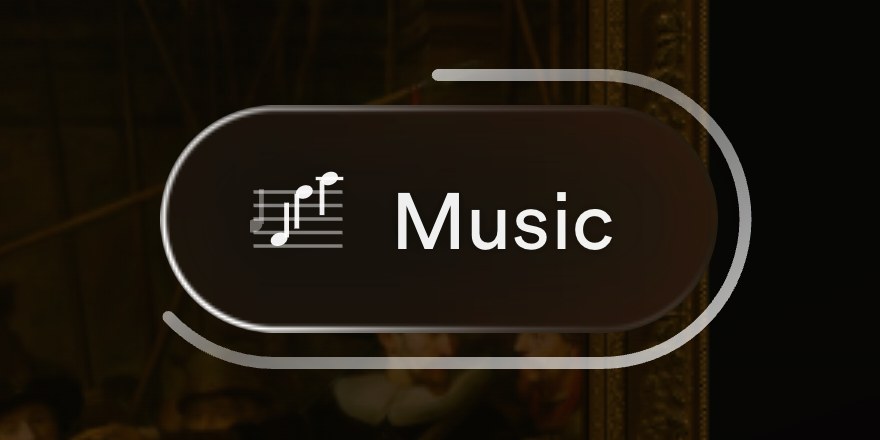
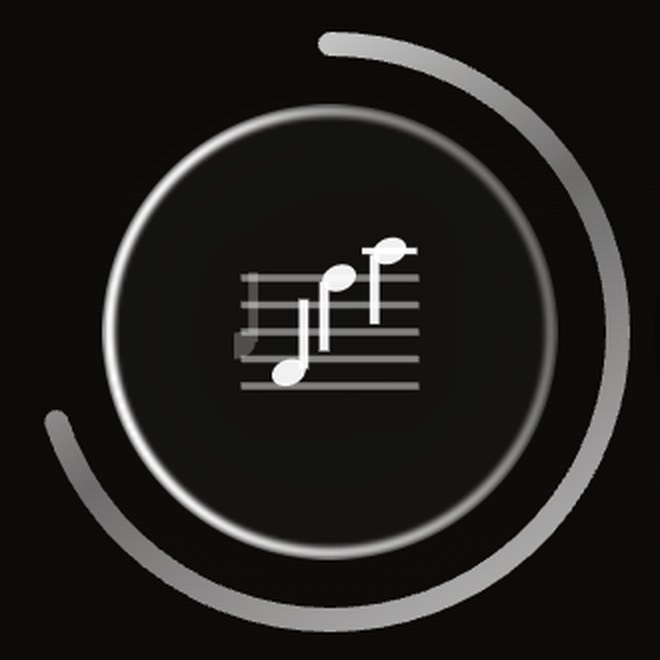
The front door has one more control: a button for the music. It plays six recordings in turn, all in the public domain: Satie’s first Gymnopédie, the Aria from Bach’s Goldberg Variations, his Prelude in C and Air on the G String, Chopin’s Nocturne in E-flat and the Moonlight Sonata. It’s a pill of the same clear glass, just before Walk the museum; on a phone, a circle.
Its icon is a bar of a score. The page listens to the music as it plays, hears each note as it’s struck and works out its pitch, and puts it on the staff, so the notes come in at the right as they’re played and drift away to the left. Mute it and they stop where they are, and a stroke draws through them.
Around the button runs a ring that shows how far the piece has got. I wanted it to feel like part of the glass rather than a progress bar laid over it.
- It’s a line of light 4px out from the glass, following its round ends. It starts at the top and draws on clockwise as the piece plays, and when the next piece begins it winds back to the top.
- It’s lit the way the glass’s own edge is: brightest where it faces the light from the top left, dimmer at the sides, a little brighter again on the far side.
- Its leading end listens to the music. When the music swells above how loud it has been over the last few seconds, the end reaches a few pixels forward and springs back a little past where it was. A struck chord pulls it; a held note lets it settle. It never reaches far enough to look broken.
- The button catches its light. Beside the end of the line, the glass’s edge brightens, faintly at rest and strongly on a swell, as if the line were reflected in it.
- With reduced motion on, it shows how far the piece has got and nothing more.
- Mute the music and the ring fades away, and the glint on the glass with it. Play it again and the ring fades back in, as far round as the piece has got.
Numbers like these can’t be decided in the abstract, so I tuned them by eye on a page with nothing on it but the button on black, the music playing, and a slider for each one: the gap, the width of the line, how far the end reaches, how stiff its spring is, how big a swell has to be to move it.
How it’s built
- three.js for the hall, with bays that repeat around you so it never ends
- Blender Cycles and Open Image Denoise for the baked lighting, driven by the same geometry as the scene
- A Liquid Glass library of my own, refracting by Snell’s law, with a glass lab to tune it and a storybook of every control in every state
- Lenis for the endless scroll and GSAP for timing, the fade up from dark and the handwritten labels
- The Web Audio API to hear the music as it plays, for the notes on the music button’s staff and the ring that moves with it
- Each painting’s size from Wikidata and its photograph from Wikimedia Commons, cropped to the painted surface
- Narration recorded with ElevenLabs in Peter Baker’s voice from its voice library, and timed word by word with Whisper, which drives both the guided look and the words that follow the voice
- Vite, deployed on Vercel, with a service worker that keeps the museum on your device
What it took
I gave this everything I had. It’s in the details nobody asked for: two sources behind every fact, 412 moments where the view glides in to what the narrator names, a frame that meets its canvas with no gap, track lights aimed about 31° off vertical, after the Rothko room. Each one was a way to get a little closer to the feeling of standing in those rooms, and I couldn’t leave one alone until it felt right.
When it was done I was spent, and empty in a way I didn’t expect, like stepping out of a museum onto the street after a long afternoon inside. Everything I had is in there now.
Walk it at estheet.com.